Shōhō era
The Book of Five RingsThe Shōhō era is the historical dating framework attached to the closing of The Book of Five Rings. Its second year, 1645, is given in the concluding date before the names of Terao Magonojo and Miyamoto Musashi, placing the work’s final inscription within the same year in which its opening account describes Musashi writing on Mount Iwato.
The Closing Date
The book’s last dated line records the twelfth day of the fifth month in the second year of the Shōhō era. It is followed by the name Terao Magonojo and then the signature SHINMEN MUSASHI. The dating therefore belongs to the work’s concluding paratext, where date and names mark its transmission and attribution; it is not presented as a date for a narrated battle or other episode.
A Frame Across 1645
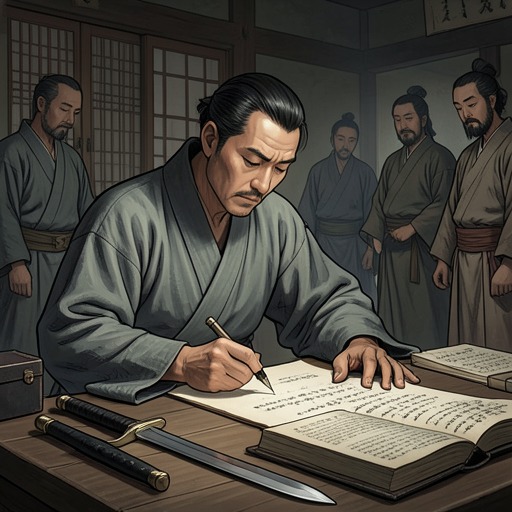
The closing date gains context from the introduction, which places Musashi on Mount Iwato in Higo Province during the first ten days of the tenth month in the twentieth year of the Kan’ei era. There, at age sixty, he says he has climbed the mountain to pay homage to heaven, pray to Kwannon, and kneel before Buddha, and that he is setting down his school’s teaching for the first time. The introductory account gives the night of the tenth day of that month as the moment of writing, at the hour of the tiger, between three and five in the morning.
Together, the two dates locate distinct parts of the book in 1645: the opening’s account of composition in the tenth month and the closing inscription dated to the fifth month. The text does not explain the relationship between those dates, so they should not be collapsed into one occasion. Their placement instead frames the work with a statement of its authorial undertaking at the beginning and a dated signature at the end.
The Work’s Conceptual Frame
The closing date stands after the Book of the Void, which describes the void not as mere ignorance or bewilderment but as something understood through knowledge of what exists and what does not. The book’s larger structure has already been laid out as five parts—Ground, Water, Fire, Wind, and Void—with the Void associated with nature and the apprehension of rhythm. The Shōhō-era inscription thus closes a work whose final subject is not a dated historical event, but the limits and possibilities of understanding strategy.
The date also sits beside a text that distinguishes its own claims from received authority: Musashi says he did not rely on Buddhist law, Confucian teachings, old war chronicles, or books of tactics when explaining the Ichi school. At the same time, the opening records acts of reverence, and the book describes strategy as following nature. The era notation supplies a concrete historical marker for this authored work without resolving those different sources of religious and strategic language.